CIBIL MSME Rank
Introduction
For Indian businesses, loan approvals today are dependent less on projections and more on financial behaviour.
Why should you - a business owner, care about this? In India, where over 63 million MSMEs contribute around 30% to the national GDP, knowing and improving your CIBIL MSME rank can be the difference between growing and surviving because the relationship between business loans & CIBIL rank is inseparable.
MSMEs need loans to meet different financial requisites, including purchasing equipment, managing cash flow, expanding operations, and hiring staff. CIBIL MSME rank is the first thing lenders check before evaluating a loan application.
This blog explains the CIBIL MSME rank meaning, how ranks are calculated, what CMR1 to CMR10 mean, and how businesses can position themselves better for loan opportunities.
Key Takeaways
- A good CIBIL MSME Rank (CMR 1-4) increases your chances of getting approved for loans with better terms.
- If your CMR is low, it’s important to seek professional help.
- Addressing issues with your CIBIL MSME Rank early helps avoid funding delays, restrictive loan terms, and missed business opportunities.
- Credit Help India assists businesses in understanding what is holding their CIBIL rank back and correcting it before funding options get limited.
Meaning of CIBIL MSME Rank & What It Means for Your Business
CIBIL MSME rank meaning states by TransUnion CIBIL and India's other three leading credit bureaus, explains:
The full form of CMR is CIBIL MSME rank which is a numeric ranking assigned to MSMEs based on their financial and repayment behaviour.
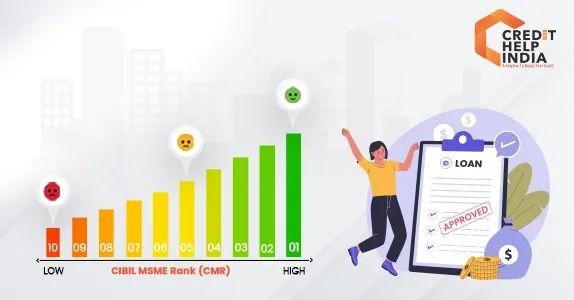
CIBIL MSME Rank (CMR) ranges from 1 to 10, where 1 represents the least risky, and 10 indicates the highest risk. This rank is crucial for MSMEs seeking financial help and loans from banks and financial institutions in India.
Get Commercial Credit Information Report for Your Business & Assess Your Company's Credit Rank
How Is CIBIL MSME Rank Calculated? (Key Factors Explained)
1. Credit History and Behaviour:
The CMR calculation highly focuses on the credit history of the MSME.
2. Credit Exposure:
The total amount of credit exposure, which consists of the current balances of all loans and credit facilities, is also a factor to consider.
3. Utilisation of Credit Facilities:
The amount of available credit the business uses is also considered.
- High utilisation can signify financial stress.
- Low utilization signifies healthy financial management.
4. Credit Type:
The type of credit facilities such as secured or unsecured.
5. Industry Risk:
The risk associated with the industry in which the MSME operates is considered.
6. Loan Enquiries and New Credit:
The frequency of new loan enquiries and recent credit taken by the business can also affect the CMR and is considered while calculating it.
- Repeated loan inquiries might suggest that the business is seeking more credit, which can be anticipated as a sign of financial stress.
Lenders do not manually compute this rank. It is built on past data reported by banks and financial institutions. If this data signals risk, future funding outcomes rarely improve on their own and often need guided financial correction.
Want to Check Your Company’s Credit Rank?
Importance of CIBIL MSME Rank for Your Business and How It Impacts Business Loans
For banks and NBFCs, this rank helps them decide whether your business is financially dependable, moderately risky, or high risk based on past behaviour.
1. Access to Credit Easily
It's the first thing lenders check when you apply for a business loan, overdraft, or credit line. A strong rank (CMR 1, 2, 3) increases your chances of loan approval.
When it comes to applying for loans without collateral, your CMR becomes the most critical factor for the lender's decision.
2. Better Loan Terms & Cost of Capital
A high rank signals low risk, allowing you to negotiate for the best available interest rates. This directly reduces your EMI burden and cost of funds.
Lenders are more confident in extending larger credit limits to businesses with a proven track record of responsible borrowing.
You may get longer repayment tenures, lower processing fees, and more flexible covenants.
3. Faster Loan Processing
A high CMR enables a smoother, faster loan process. Lenders rely on the rank as a trusted metric, reducing the need for excessive documentation and manual verification, leading to quicker disbursals.
4. Separation of Personal & Business Finances
A strong CMR helps you establish your business as a separate, creditworthy entity. This reduces your personal liability and reliance on your personal credit score (CIBIL).
It demonstrates financial discipline and maturity to potential partners, vendors, and investors.
5. Strategic Planning & Growth
Your CMR is a mirror to your business's financial behaviour. Monitoring it helps you identify areas for improvement (e.g., high credit utilisation, delayed payments).
A good rank means you are a trustworthy borrower when a sudden growth opportunity, bulk order, or need for emergency funds arises. You don't have to start building credit from scratch.
6. Trust & Credibility with Vendors & Partners
While primarily for lenders, a good credit profile can be shared with potential partners or large vendors to establish trust, especially when negotiating payment terms or entering into contracts.
For businesses, the impact is measurable:
- Strong rank → faster loan processing
- Weak rank → higher chances of rejection
- Better rank → improved interest terms
- Poor rank → limited lender options
In competitive lending environments, lenders first check the CIBIL rank. Businesses with favourable ranks move ahead. Others are evaluated cautiously or declined
Check Your CIBIL MSME Rank Now
Understanding Different CIBIL MSME Ranks and What They Mean (CMR1 - CMR10)
CIBIL MSME rank table highlights what each CIBIL MSME Rank (CMR) signifies for businesses in India:
| CMR RANK | Meaning & Risk level | Creditworthiness |
|---|---|---|
| CMR 1 | CMR rank 1 indicates the no or lowest risk. Businesses with this rank are considered the most creditworthy, suggesting strong financial health and a low risk of default. | Superior |
| CMR 2 | CMR 2 indicates a very low risk. CIBIL MSME rank 2 states that the businesses are very stable, have a consistent repayment history, and have sound financial practices. | Superior |
| CMR 3 | CMR 3 indicates low risk. CIBIL MSME rank 3 states that the businesses are well-established with solid financial stability and are at a low risky business. | High |
| CMR 4 | CMR 4 indicates moderately low risk. CIBIL MSME rank 4 states that the businesses under this rank are generally stable and have good credit history, but might have some areas of concern that need monitoring. | Moderate |
| CMR 5 | CMR 5 indicates moderate risk. CIBIL MSME rank 5, states that the businesses have acceptable credit histories but might face financial stability challenges. | Moderate |
| CMR 6 | CMR 6 indicates moderately high risk. CIBIL MSME rank 6 states that businesses have potential financial stress and some risk of defaulting on obligations. | Poor |
| CMR 7 | CMR 7 indicates a higher risk. CIBIL MSME rank 7 signifies that the businesses are likely to have financial issues, including higher chances of late payments or defaults. | Poor |
| CMR 8 | CMR 8 indicates a very high risk. CIBIL MSME rank 8 states that the businesses show significant signs of financial stress, which may lead to default. | Poor |
| CMR 9 | CMR 9 indicates extremely high risk. CIBIL MSME rank 9 meaning states that the businesses are at a very high probability of default and adverse credit situations. | Very Poor |
| CMR 10 | CMR 10 indicates the highest risk. CIBIL MSME rank 10 states that the businesses are most likely to default and have the poorest financial health. | Very Poor |
Benefits of a Good CIBIL MSME Rank
- A good CMR will instantly give access to better loan options, potentially securing lower interest rates and more favourable repayment terms.
- MSMEs can effectively use a good CMR to negotiate better financial deals, uplifting their ability to manage costs effectively.
- Lenders rely heavily on CMR to assess credit risk efficiently, which leads to faster loan approvals for businesses.
- A favourable CMR will uplift the credibility of MSMEs & help them expand business opportunities.
Want to Have Good CIBIL MSME Rank?
What is a Good CIBIL MSME Rank for a Business Loan?
A CIBIL MSME Rank between CMR1 and CMR4 is generally considered favourable for business loan approvals.
| CIBIL Rank Range | Risk Level | Loan Approvals |
|---|---|---|
| 1-2 | Very low risk | Strong eligibility |
| 3 | Low risk | Good approval potential |
| 4-5 | Moderate risk | Eligible with conditions |
| 6-7 | Moderate to high risk | Limited lender options |
| 8-10 | High risk | Approval unlikely without correction |
If your rank falls in the moderate or higher-risk range, the next practical step is to get your company's credit report now.
How to Check and Improve CIBIL MSME Rank
Your CIBIL MSME Rank (CMR) is an essential indicator of your business’s credit health, influencing loan approvals, interest rates, and credit terms. Knowing your CBIL MSME rank and how to improve it can give your business a competitive advantage in securing financing.
Checking your CMR is an easy online process involving your business details and verification, while improving it requires consistent financial discipline, such as timely repayments, lowering credit utilisation, and maintaining a healthy credit profile.
For a complete step-by-step guide on accessing your CIBIL MSME rank and strategies to improve it, read our detailed blog - How to Check and Improve CIBIL MSME Rank (CMR)?
FAQs
1. What is CIBIL MSME Rank and why is it important for businesses?
CIBIL MSME Rank is a ranking system that indicates a business’s financial reliability based on past repayment and borrowing behaviour. It is important because lenders use it to assess risk, decide loan eligibility, and determine terms before approving business finance.
2. What is the significance of CIBIL MSME Rank for lenders?
For lenders, CIBIL MSME Rank offers a standardised risk indicator. It helps them evaluate repayment discipline quickly, compare applicants objectively, and reduce lending uncertainty.
3. What does CMR1 to CMR10 mean in CIBIL MSME Rank?
CMR1 to CMR10 meaning reflects risk levels. Lower ranks indicate stronger financial discipline and lower lending risk. Higher ranks indicate inconsistent repayments or financial stress, making lenders restrictive in approvals.
4. What is a good CIBIL MSME Rank for a business loan?
A CIBIL MSME Rank between CMR1 and CMR4 is considered good for business loans. It signals low to moderate risk, improves approval chances, and often results in better lending terms and faster processing.
5. Can I get a business loan with a low CIBIL MSME Rank?
Yes, but options may be limited. A low CIBIL MSME Rank can lead to higher interest rates, stricter conditions, or partial approvals. Improving repayment behaviour before applying can significantly improve outcomes.
6. How can I check my CIBIL MSME Rank?
You can check your CIBIL MSME Rank by getting your Company’s Credit Information Report.
Conclusion
At Credit Help India, the focus is on helping businesses understand what their CIBIL MSME Rank actually indicates and what needs correction, clearly, practically, and in line with lender expectations.
Knowing where your business stands today allows you to plan funding decisions with confidence tomorrow.
rn.latestfull {rn background-color: #ef6e38;rn border-radius: 8px;rn padding: 10px;rn margin-bottom: 10px;rn}rn.page-node-61195 p.leftline2:before {rn background-color: #ff7812;rn display: inline-block;rn position: absolute;rn left: 0px;rn width: 4px;rn height: 50px;rn content: "";rn}rn.page-node-61195 p.leftline2 {rn position: relative;rn padding-left: 10px;rn}rn.latestfull p {rn color: #fff;rn font-size: 20px;rn font-weight: bold;rn padding-bottom: 0px;rn padding: 10px 10px 0px 10px !important;rn}rn.page-node-61195 p.leftline1:before {rn background-color: #ff7812;rn display: inline-block;rn position: absolute;rn left: 0px;rn width: 4px;rn height: 30px;rn content: "";rn}rn.page-node-61195 p.leftline1 {rn position: relative;rn text-decoration: underline;rn padding-left: 10px;rn}
Frequently Asked Questions
CIBIL is a repository of information that collects and maintains the data provided by Banks and NBFCs, where individual have or had loans in the past. It has information about individual past and present repayment history and the status of individual loan accounts, personal information such as individual identity information, employment history, contact information, etc. It also keeps track of all the enquiries that individual has made for credit from various banks and financial institutions.
Get your credit fixed. Open doors to better
loans, cards, and rates.
Loan rejection, low score, no credit history or starting a new business we find what's wrong and fix it.