
7 Expert Tips to Improve Your CIBIL Score
Introduction
Banks don’t look at intentions; they look at behaviour.
Missed payments and delays slowly drag your credit score down over time. That’s why learning how to increase the CIBIL score is the only correct action towards disciplined, structured credit behaviour and with that this blog consists of CIBIL improvement tips, one of the essential foundations for building a strong financial profile.
So, let’s get started!
Key-Takeaways
- Never miss payments - timely payments are the most important factor for a high score.
- Use less than 30% of your credit limit to avoid looking financially overstretched.
- Apply for loans in the gap of 3–6 months to minimise hard inquiries.
- Keep old accounts open and check your credit report for errors to build history and correct inaccuracies.
- Be consistent and patient, credit score improvement typically takes 3–12 months of disciplined behaviour.
What is the CIBIL Score (Or Credit Score)?
A CIBIL score is a three-digit number (300–900) that reflects your creditworthiness based on repayment history, credit usage, and borrowing behaviour.
A CIBIL score is calculated by four major credit bureaus. It summarises how responsibly you manage credit, such as loans and credit cards. Banks and NBFCs use this number to assess lending risk under guidelines regulated by the Reserve Bank of India.
There are multiple factors affecting CIBIL score, that includes :
- Payment history
- Credit utilisation
- Credit mix
- Length of credit history
- Recent credit enquiries
A lower score signals high risk, while a higher score improves loan approval chances and interest rates.
What is a Good CIBIL Score?
A CIBIL score of 750 or above is considered excellent, whilst scores between 700-749 are good.
Classification of credit scores in India:
| Credit Score Range | What does it mean? |
|---|---|
| 300-549 | Poor |
| 550-649 | Fair |
| 650-749 | Good |
| 750-900 | Excellent |
If you’re aiming for loans with better interest rates, reaching 750 is important. Most banks prefer applicants who show consistent repayment behaviour rather than quick, risky borrowing. This is why structured CIBIL score improvement tips matter more than any other shortcuts available in the market.
Why Do You Need a Good CIBIL Score? What are the Benefits of It?
A good CIBIL score is essential for loan approvals, lower interest rates, higher credit limits, faster loan processing, and better financial opportunities.
Loan and Credit Card Approvals: The minimum CIBIL score for loan approval varies by lender, but most banks require at least 700-750 for personal loans, home loans, or car loans. With a poor CIBIL score, your applications face rejection regardless of your income.
Lower Interest Rates: The difference between a 650 score and a 750 score can mean a 2-4% variation in interest rates. On a ₹25 lakh home loan over 20 years, this could save you ₹5-8 lakhs in interest payments.
Higher Credit Limits: Credit card companies and lenders offer higher limits to those with excellent scores. This provides financial flexibility during emergencies.
Faster Processing: Applications from borrowers with good credit cores move through approval processes quickly, sometimes within hours, whilst lower scores trigger detailed scrutiny and delays.
Better Negotiating Power: With an excellent CIBIL score, you can negotiate with lenders for better terms, reduced processing fees, or lower interest rates.
Rental Agreements: Landlords increasingly check credit scores before renting properties, especially in metro cities.
Understanding these benefits should motivate you to follow ways to improve CIBIL score consistently. Whether you need to increase CIBIL score for an immediate loan requirement or for long-term financial health, the effort pays substantial dividends.
How to Increase CIBIL Score Fast - 7 Smart Ways
Pay all dues on time, reduce credit utilisation below 30%, clear outstanding debts, avoid multiple loan enquiries, maintain old credit accounts, diversify your credit mix, and regularly monitor your credit report for errors.
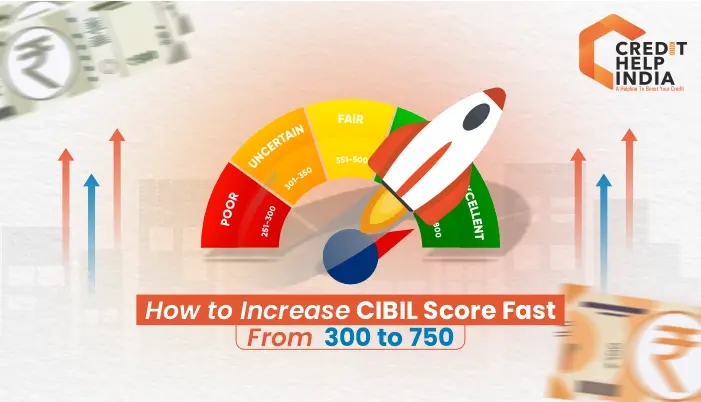
Here are seven proven tips to increase CIBIL score from a poor 300 to an excellent 750: (Remember, these tips will be the same if you want to increase your CIBIL score from 500 to 750, or 600 to 750)
1. Pay All Bills and EMIs on Time
This is the single most important factor in credit score improvement. Payment history constitutes approximately 35% of your CIBIL score calculation.
You ask whether late payment affects the CIBIL score? Absolutely. Even a single missed payment can drop your score by 50-100 points, whilst multiple defaults can destroy it.
Solution: Set up automatic payments or standing instructions for all credit cards and loan EMIs. Pay at least 5-7 days before the due date to account for processing delays. If you've missed payments, start now. Consistent on-time payments over 6-12 months can significantly increase the CIBIL score.
2. Reduce Credit Utilisation Below 30%
Credit utilisation is the percentage of your available credit limit that you're currently using. High utilisation suggests financial stress and negatively impacts your score.
If your credit card has a ₹1 lakh limit, keep your monthly spending below ₹30,000. Better still, aim for 10-20% utilisation. This is one of the fastest ways to improve CIBIL score because credit utilisation updates monthly.
Solutions to lower utilisation:
- Request credit limit increases on existing cards
- Make multiple payments within the same billing cycle
- Spread expenses across multiple cards
- Avoid maxing out cards even if you pay in full
3. Clear Outstanding Dues and Settle Debts
Outstanding debts, especially those marked as "written off" or "settled," severely damage your score. These negative marks remain on your credit report for seven years.
What can you do?
- Credit card dues carry high interest
- Small personal loans that can be closed quickly
- Any defaults or overdue amounts
If you cannot pay the full amount, contact lenders to negotiate a settlement. However, understand that "settled" status still impacts your score negatively, though less than "written off." The ideal approach is to pay the full outstanding amount.
This CIBIL score improvement tip requires discipline but delivers visible results within 3-6 months.
4. Avoid Multiple Credit Enquiries
Each time you apply for a loan or credit card, the lender makes a "hard enquiry" on your credit report. Multiple enquiries in a short period signal credit hunger and can reduce your score by 10-20 points per enquiry.
You must be thinking that checking CIBIL score frequently is bad? No. When you check your own score, it's a "soft enquiry" that doesn't affect your score. Only lender enquiries impact it.
To understand this better, you can read our detailed blog on Hard Inquiry vs Soft Inquiry.
Best Practices:
- Space out loan applications by at least 3-6 months
- Research and apply only to lenders likely to approve your application
- Use pre-approval or eligibility check services that don't trigger hard enquiries
- Avoid applying for multiple credit cards simultaneously
5. Maintain Old Credit Accounts
The length of your credit history contributes to your score. Older accounts demonstrate long-term credit management capability.
Don't close old credit cards even if you're not using them actively.
Solution:
- Keep them active with small purchases every 3-6 months
- Pay off the balance immediately
- Set up a small recurring payment like a mobile recharge
If you've recently opened accounts and have a poor credit score, focus on building history. Your credit age improves naturally over time, one of the easy tips to improve CIBIL score.
6. Diversify Your Credit Mix
Having a healthy mix of secured loans (home, car) and unsecured credit (credit cards, personal loans) positively impacts your score. It shows you can handle different types of credit responsibly.
If you only have credit cards, consider a small secured loan against a fixed deposit. If you only have loans, getting a credit card and using it responsibly helps.
However, don't take unnecessary credit just for diversity. Apply this strategy only when you genuinely need credit and can manage repayments comfortably.
7. Monitor Your Credit Report and Dispute Errors
Errors in credit reports are surprisingly common, including incorrect personal information, accounts you didn't open, or payments wrongly marked as late.
Check your credit score for free and review the detailed credit report.
Solution:
- Raise a dispute directly with CIBIL through their online portal
- Provide supporting documents (bank statements, payment receipts)
- Follow up until the error is corrected
Correcting errors can instantly boost your credit score. In some cases, people have seen increases of 50-100 points after removing incorrect negative marks.
For complex situations involving multiple errors or uncooperative lenders, you might consider a CIBIL score improvement agency that specialises in dispute resolution and credit score repair.
These tips work best no matter if your goal is to increase CIBIL score from 500 to 750 or to increase CIBIL score from 600 to 750; the discipline and approach remain the same.
Timeline for Results - How Much Time Will It Take To Improve CIBIL Score?
CIBIL score improvement usually takes 3 to 12 months, depending on severity, repayment consistency, and credit behaviour.
There is no instant solution or method. Recovery comes from consistent behaviour aligned with RBI-approved lending norms. The best way to increase a CIBIL score is patience combined with disciplined action.
FAQs:
1. How can I increase my CIBIL score quickly?
Pay dues on time, reduce credit utilisation, and avoid new enquiries.
2. How long does it take to improve my CIBIL score?
Typically 3–12 months.
3. Fastest way to improve CIBIL score?
Clear overdues and maintain low credit usage.
4. How to increase CIBIL score from 500 to 750?
Pay all dues on time, reduce credit utilisation below 30%, clear outstanding debts, avoid multiple loan enquiries, maintain old credit accounts, diversify your credit mix, and regularly monitor your credit report for errors.
5. Minimum CIBIL score for loan approval?
Usually 650+, ideal is 750.
6. Does late payment affect CIBIL score?
Yes, significantly.
7. Is checking CIBIL score frequently bad?
No, self-checking your CIBIL score does not affect your score.
8. How to increase CIBIL score from 600 to 750
Pay all dues on time, reduce credit utilisation below 30%, clear outstanding debts, avoid multiple loan enquiries, maintain old credit accounts, diversify your credit mix, and regularly monitor your credit report for errors.
9. CIBIL score is very low-what to do?
Start repayments, correct errors, seek expert help.
10. How to increase CIBIL score from 300 to 750
Pay all dues on time, reduce credit utilisation below 30%, clear outstanding debts, avoid multiple loan enquiries, maintain old credit accounts, diversify your credit mix, and regularly monitor your credit report for errors.
11. Will I get a loan if my CIBIL score is low?
Possible, but with higher interest or stricter terms.
12. How to repair credit score
1. Pay all EMIs and credit card dues on time
2. Maintain a Credit Utilisation Ratio below 30% of your total limit
3. Check your latest credit report for any inaccuracies and file a dispute if found quickly
Conclusion
Rebuilding your CIBIL score from 300 to 750 is challenging but achievable with the right approach. The seven ways to improve CIBIL score outlined in this guide have given you one brilliant, comprehensive credit score improvement strategy.
Start today by implementing at least three of these tips to improve your CIBIL score. Credit Help India supports this journey by guiding borrowers to rebuild their credit profiles responsibly with Indian lending practices.